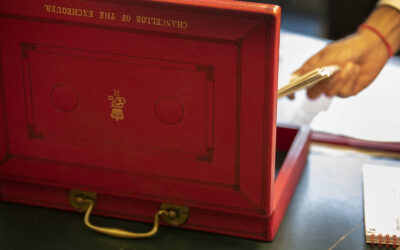
Last week it emerged that Number 11 has decided against one of the biggest potential tax changes being considered for the upcoming Autumn Budget. According to sources first reported byThe Times, the Chancellor has decided not to increase the rate of capital gains tax (CGT) to move it towards income tax rates.
There is influential support both inside and outside the Cabinet for greater equality between taxing gains from assets (currently taxed at 18 or 24 percent), and income from work (20 / 40 / 45 percent). Defence Secretary Wes Streeting, for instance, previously called equalizing CGT and income tax rates “a wealth tax that works” during his leadership bid. His Cabinet Office colleague Louise Haigh has said it is “central to restoring confidence that the system does not favour those able to structure their income over those earning through work”.
The level of pre-Budget leaks this year hasn’t approached anywhere near last year’s months-long kite-flying. There are reports that the Budget team is subject to titanium-grade levels of info-sec brought over from Healey’s time at the Ministry of Defence. So this leak feels very pointed.
Last week’s reports cite two main reasons for the Chancellor’s reticence to tamper with capital gains tax. First: anxiety about an exodus of the wealthy individuals who predominantly pay CGT. (Just 0.65% of the adult population pay capital gains tax, and two-thirds of the revenue comes from taxpayers realizing gains of over £1 million).
The empirical basis for this anxiety is unclear. The key statistical source for much of the public reporting on the level of ‘wealthy exits’ has now been comprehensively debunked, and in some individual cases reports of moves have been simply false, as TaxWatch showed two weeks ago. Eleven campaign groups recently called on press regulator IPSO to investigate media coverage of ‘millionaire exit’.
A clearer evidential justification for the decision is the government’s own estimates for what will happen to tax revenues if rates and thresholds are changed. These are summarised in the snappily-titled “Direct Effects of Illustrative Tax Changes Ready Reckoner”, published annually since 2013. Multiple news organisations, from the Financial Times to the Guardian, reported last week that Treasury officials have been pointing to HMRC’s estimates that
businesspeople would respond to a CGT increase by changing their behaviour — leaving the UK or delaying asset sales, for example — and spurring a drop in revenue for the exchequer.
In reporting the story, journalists and commentators from the BBC to the ex-CEO of the Taxpayer’s Alliance have cited HMRC’s ‘ready reckoner’ statistics about dramatic revenue losses from raising the CGT rate.
What do the ‘ready reckoner’ figures say?
Historically, HMRC’s model has predicted that raising the CGT upper rate by a modest 1% would lead to declining revenue gains over time – though until 2025, the model nonetheless projected a net revenue increase.
In the 2024 and 2025 editions, HMRC also began publishing its model’s predictions for revenue effects of much larger increases in the CGT upper rate of 5 or 10 percent. For these, the model predicted revenue reductions of several billion pounds (below), with the 2025 edition of the model significantly more pessimistic than the 2024 edition. And for the first time, the 2025 edition also predicted a net reduction in CGT revenue for just a 1% increase in the upper rate (below).
The ‘Illustrative tax changes ready reckoner’ is arguably one of the most influential spreadsheets in Whitehall. Faced with predictions like this – which the OBR could potentially reproduce in its Budget policy costings – what Chancellor would risk announcing a tax rise that the government’s own figures predict would actually reduce their fiscal headroom at the back end of this parliament, as an election approaches?
For such an important body of statistics, it’s striking that HMRC doesn’t publish any significant details of the model behind its revenue predictions. It’s reasonable to assume that the 2025 edition is much more pessimistic about CGT rises because it’s starting from higher rates of CGT than in previous years, following the CGT rate rises of the October 2024 budget. But we don’t know what assumptions drive the predicted revenue reduction from increasing CGT rates. Is it that HMRC predicts that asset sales will be deferred? That the higher rates will be more effectively avoided? That taxpayers will cease to be UK tax-resident (though in many cases gains from assets in the UK will be taxed in the UK wherever their owners reside)? Nor do we know what design aspects and thresholds are built into the model, what multipliers it uses, or what data they are based on.
But there’s a bigger problem. On 6 July, just 24 hours before HMRC was due to publish the 2026 edition of its ‘ready reckoner’ figures, it placed a statement on its website that:
HMRC has deferred publication of the Direct Effects of Illustrative Tax Changes Bulletin to allow for a completion of a review of the key assumptions underpinning some of the estimates in the bulletin. An updated publication date will be announced in due course.
In other words, there is no current edition of the highly influential spreadsheet, widely cited as driving the Chancellor’s decision on possibly the Budget’s biggest tax design decision. And HMRC is in the process of revising the key assumptions of the model underpinning past versions.
This week HMRC was unable to say when the revised edition would be published, telling TaxWatch that “We’re committed to providing accurate information, so it is important that we complete this review. We’ll provide an update on the publication date in due course.”
Asked whether the CGT model was one that was being revised, HMRC did not confirm or deny this but said: “As explained above, we are reviewing key assumptions underpinning the estimates.”
HMRC also declined to answer whether it still considered that the CGT revenue predictions in the 2025 edition are valid. It responded simply: “The 2025 bulletin is the latest bulletin available. We will be publishing a new bulletin in due course”.
Disputed numbers
Tax rises certainly have complicated behavioural effects, especially for ‘lumpy’ and voluntarily-triggered events like asset sales. The 2024-5 CGT statistics do suggest that asset sales’ timing is particularly sensitive to announcements of tax rate rises. Nonetheless the ready reckoner’s CGT revenue predictions are some of the most contested of any of HMRC’s models. Across all the different taxes, its models for CGT and the additional rate of Stamp Duty Land Tax are the only that predict revenue reductions from rate increases. The influential Centre for the Analysis of Taxation (CENTAX) at the University of Warwick and the London School of Economics has produced its own CGT model using HMRC’s own anonymised data, and predicts the opposite to HMRC.
CENTAX’s alternative model proposes equalising CGT and income tax rates – alongside investment and loss allowances to ensure only real gains are taxed, and three specific measures to prevent CGT being avoided. This package, it finds, would raise an additional £14 billion annually.
CENTAX’s package of changes is different to the isolated change of rate that HMRC models. Nonetheless, referring to HMRC’s influential ‘ready reckoner’, CENTAX reiterates that we simply don’t know how HMRC has arrived at its doom-y estimates of revenue reduction:
There is no information in the public domain about how HMRC obtained their estimate. If the elasticity underlying HMRC’s behavioural model is estimated from past reforms to CGT in the UK, it would not be suitable for analysing the behavioural effects of the package of reforms that we propose due to large contextual differences. We adopt a different approach that involves taking the best available evidence from the international literature and applying adjustments to account for the specific features of our proposed policy setting.
TaxWatch takes no position on rates and levels of taxation. We’re concerned with a rational and well-administered tax system, with limited opportunities for avoidance, disincentives for evasion, and fair enforcement of the rules whatever they are.
But we do believe that tax policymaking should be based on good data, not hunches or anecdote. And we think that for such important decisions, people and parliament should be able to see the numbers, models and assumptions underlying them.
In this case: at best a major Budget decision is being heavily influenced by a model we can’t see – and in fact has already been withdrawn. At worst, it’s being made based on HMRC figures that HMRC itself doesn’t think are right any more.
We don’t know what’s going to be in the Chancellor’s speech on Wednesday. But afterwards, as MPs debate the subsequent Finance Bill, they should be told whether HMRC still has faith in the models and assumptions that underpin it.
**
Photo: HM Treasury / Flickr