Two weeks ago the leader of the Opposition told Parliament that
On Monday, Chris Rokos, Britain’s third biggest taxpayer, announced that he was leaving the country. That is £330 million of taxes walking out the door because of this Labour Government – every year, £330 million.
Others used the same figure to press the government in both the Commons and the Lords.
For several years we’ve seen newspapers and politicians raising fears about a ‘billionaire exodus’ from the UK. We’re told that recent changes to capital gains tax, inheritance tax, trust and non-dom taxation may be driving very wealthy people to shift their tax residence out of the UK. And this, the argument goes, means that they will take with them both their productive economic activities, and their outsize tax payments.
In fact, there’s no hard evidence that greater numbers of wealthy people are leaving the country than usual, or fewer arriving. Several of the surveys and wealth industry reports used to evidence this viewpoint have been thoroughly debunked.
That hasn’t stopped the debate being revitalised in recent weeks by the news that hedge fund manager Chris Rokos, the owner of Rokos Capital Management, has announced plans to move to Greece and set up an office for his eponymous investment fund there.
Rokos’ philanthropy, and his UK tax bill, are both reportedly in nine figures. In February the Sunday Times’ Tax List reported that he paid £330 million in tax last year, putting him at number three in their ranking of ‘top taxpayers’. That £330 million figure has been taken up across media of all political stripes, and has now made it to PMQs.
The New Statesman magazine recently asked TaxWatch to help take a look at the structure of Rokos Capital Management, and the £330 million figure. Their article is here (the word ‘Baloney’ in the headline spares readers’ blushes for the more robust word beginning with B that the article uses).
Below we flesh out what we found – which is really an exercise in showing what we don’t (and can’t) know.
And that’s important. Individuals’ tax affairs are confidential. Rokos Capital Management didn’t respond to our request to comment on our findings, or to the New Statesman, and they have no obligation to do so. The rules about how investment funds and their managers are taxed, based on their residence and the sources of their income, are complex. We often simply can’t know how those rules are applied by HMRC. And when a business is run in a particular jurisdiction – even a business as mobile as investment management – tax liabilities in that jurisdiction can be surprisingly sticky, as we’ll discuss below.
Instead, our entire national conversation about how we tax the wealthy – inside and outside Parliament – is currently based on figures taken from a newspaper that can’t be publicly verified, uncritical and often inaccurate presentations of those figures, plus a slew of assumptions that could be wildly different based on factors we can’t see.
What we know
The Sunday Times Tax List reported in February that Chris Rokos “paid himself £476.8 million” last year, and paid £330 million in tax.
Let’s start with the £476.8 million. Rokos Capital Management doesn’t declare how much it pays Chris Rokos. Instead, £476.8 million is the amount of 2024-25 profits that Rokos’ UK fund management vehicle, Rokos Capital Management LLP, allocated to one of its corporate partners, a Jersey company called Rokos Intermediate (Jersey) Ltd. That’s about 50 percent of the profits allocated to partners that year.
We can’t in fact know whether Rokos is the only individual who ultimately benefits from that £476.8 million. The Jersey company is owned in turn by a Jersey limited partnership whose general partner is owned by Rokos, but whose allocation of profits is not on public record. The identity of its limited partners – who could be entitled to a share of the money via Rokos Intermediate (Jersey) Ltd – are also not on public record, unlike UK partnerships.
Here’s a rough diagram of what’s visible from public records in the UK and Jersey. Simple…
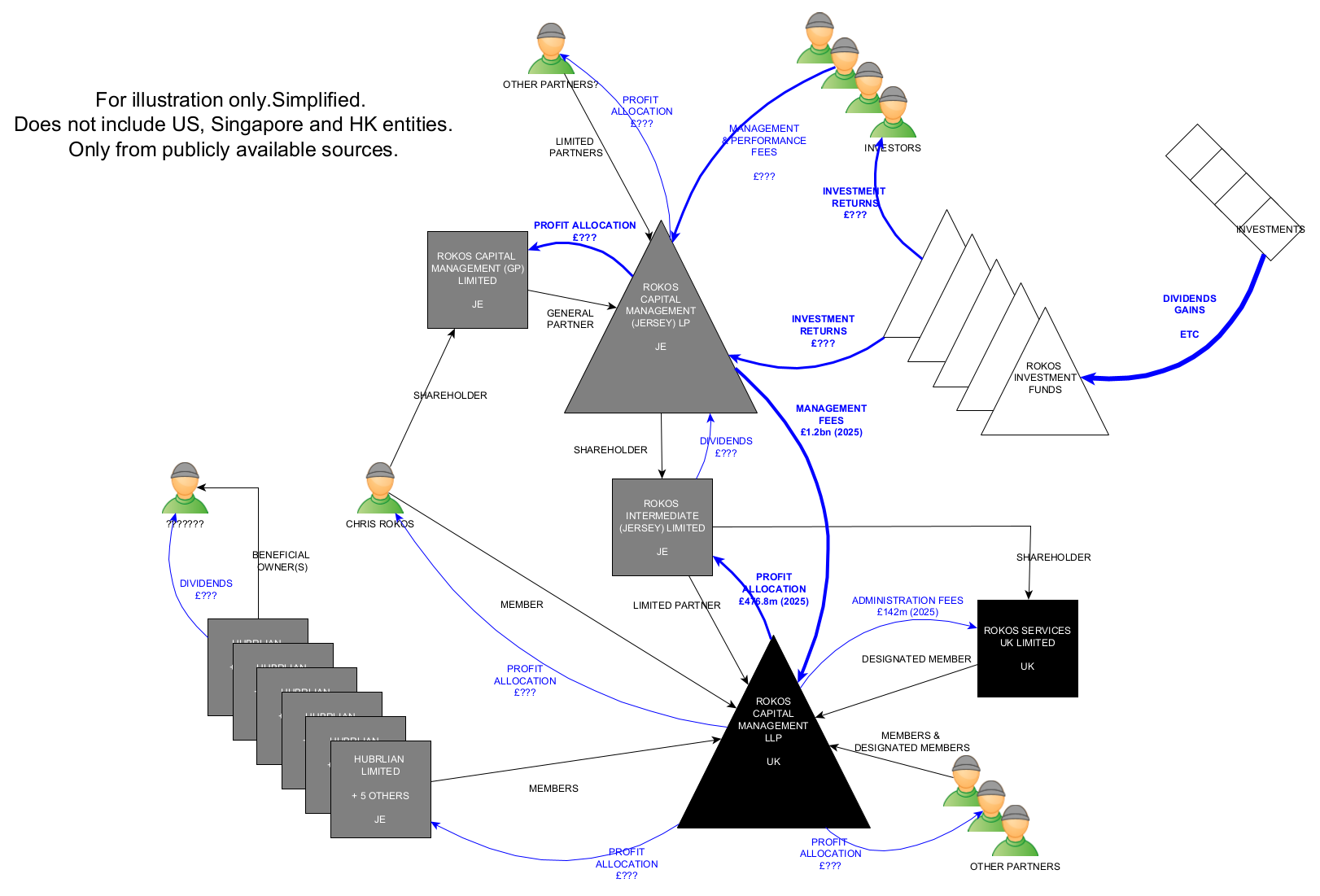
What we can see from this is that there could well be other parties we don’t know about, who could ultimately receive some of the £476.8 million paid to the Jersey company, Rokos Intermediate (Jersey) Ltd. Some of this profit allocation could also be retained within the Jersey company. We don’t know, and nor does anyone else except Chris Rokos and HMRC. (You’ll be hearing this a lot in what follows).
Even if all that £476.8 million is Chris Rokos’ remuneration, it’s likely that it’s not everything he gets paid. That sum is distributed from Rokos Capital Management LLP, whose only income is the management fees it receives. Fund managers are often also entitled to a share of the profits of investment funds themselves, which in this case are held via Jersey and other offshore partnerships. We can’t see these partnerships’ profit distributions – or how they’re taxed in the UK.
What we can see, however, is that 2024-25 – the year in which Chris Rokos’ £330 million tax bill apparently arose – was an unprecedented, bumper year for Rokos Capital Management. Management fees, and profits made from them, were larger than in any year since the UK LLP was established in 2015. In other years the partnership received less than a tenth of this amount of fees, and in 2021-22 it made a loss after administration costs.
Equally, in two of the last five years, no profits at all have been allocated to the Jersey company that the Sunday Times believes constitutes Chris Rokos’ remuneration.
There’s nothing unusual about this. Investment fund returns are typically variable and lumpy. But it means that Chris Rokos is almost certainly not paying “every year, £330 million” in UK taxes, as Parliament was told. In fact, his tax bill may never have been anything approaching that amount before 2025 (except possibly in 2021). As the New Statesman’s Will Dunn notes, Rokos has only been on the Sunday Times’ list of ‘top 50’ taxpayers twice in the last six years, in 2022 and 2026, likely reflecting the two spikes in remuneration in the graph above.
We’re making a list, we’re checking it twice
What happens to the UK’s tax take if Chris Rokos stops being UK tax-resident?
TaxWatch has written before about the methodology of the Sunday Times’ Tax List. To give the compilers credit, they work hard to gather information both from publicly available accounts, and from a range of other sources. But what they mean by an individual’s tax bill is not what most people mean. It includes all the tax paid by the (large) companies those individuals hold shares in, divided by the proportion of their shareholding.
That in itself shows an immediate problem with some of the ‘exodus’ scaremongering. In most cases, people’s real businesses can’t be moved with them to Monaco. They have employees, offices, factories and customers here in the UK that continue to generate economic activity, wealth and tax liabilities wherever the owner is resident.
Unlike many people on the Sunday Times’ list, this methodology of counting up corporate tax doesn’t work for Chris Rokos, because his business isn’t (mostly) structured via limited companies. It’s in the form of limited partnerships, registered in the UK, Jersey, and elsewhere. UK partnerships don’t pay corporation tax: instead their partners are taxed on the profits of the partnership that are allocated to them (with an exception for profits whose distribution is deferred as a performance incentive under AIFM rules – which doesn’t seem to make very much difference in the case of Rokos Capital Management).
We can’t see how profits are distributed the Jersey partnerships at all. Nor can we see how much of the management fee profits most of the partners are allocated from the UK partnership – or even who owns some of the corporate partners, which are mostly Jersey-registered companies with exotic names like Flarathis and Jostrothix Limited, whose shares are held by a trust company.
Nonetheless let’s assume for now that the Sunday Times’ £330 million figure, presumably from non-public sources, is correct. Partners of a UK partnership don’t necessarily lose all their UK tax liabilities by becoming non-resident. The partnership may not itself be taxed, but where and how the partnership makes its money matters very much for the taxation of the partners’ profits. We can see least three ways that HMRC can claim taxing rights on some of the profits allocated to non-resident partners (and maybe more – we’d welcome readers’ thoughts).
First, if the income of the partnership arises in the UK. Rokos Capital Management LLP seems to have this one covered: its accounts say that all its income – the management fees it receives from the Jersey partnership – arise in Jersey.
Secondly, though, it’s possible that HMRC considers that some of the investment income of the Jersey partnership itself arises in the UK. In some cases, foreign partnerships’ UK-origin income can be UK-taxed even when the partners are also non-resident. In this case, we don’t know.
Third: if the partnership’s profits are treated as a trade being carried on in the UK or via a UK branch. This is trickier. Some investment management activities may not qualify as a UK trade for tax purposes, and the determination interacts in complicated ways with the Investment Management Exemption (IME) – a safe harbour in UK tax law intended to make the UK a more attractive place for hedge fund managers by preventing the fact of having UK fund manager from triggering a taxable UK permanent establishment, or UK trading income tax liabilities, for non-resident investors of an offshore fund.
These rules, though, are themselves changing, both through recent updates to the IME itself, and through the reform of carried interest taxation, under which the ‘carry’ (share of investment gains) of a fund manager – including non-resident managers – is deemed to be trading income, and taxed as such. Again, the rules are both complex and new: how in practice deemed trading income is attributed to UK-performed investment management activities – by time spent in the UK, the nature of the management activity, and so on – will likely be subject to much future wrangling between taxpayers and HMRC.
Big in Berkshire
We simply don’t know how HMRC views the UK taxation of the string of partnerships and corporate partners through which Rokos Capital Management’s billions currently flow. We don’t know how it will change if and when some or all of the partners move to Greece.
What we do know is that Rokos Capital Management, irrespective of where its partners live, currently has a large UK operation servicing both its UK and US management activities. Rokos Services (UK) Limited, registered in Reading, employs over 240 people with a payroll of over £100 million. It pays corporation tax here in the UK. It even qualifies for UK research and development (R&D) credits, which since 2024 have been quite closely tied to the location where the R&D gets done.
It’s possible that Rokos Capital Management will uproot all these people too. But it seems more likely that recruitment and retention of the right people is easier here in the global financial centre of London, than in Greece. And if this back-end stays in the UK, it could also have a bearing on how, and how much, HMRC deems the funds’ management fees and investment income to be taxable in the UK.
Tax stickiness
And this is the real point. Investment management is a more globally mobile business than many others: making shoes, running a care home, building houses. In the UK, with our outsize dependence on the finance sector, we can feel vulnerable to the footloose mobility of finance titans. But even hedge funds need actual staff and operations, for which the UK is a convenient place with a globally competitive pool of talent. And in tax law, where a fund’s money is made, and taxed, is not as simple as where its fund managers live. It’s far from clear that Chris Rokos moving to Greece would wholly cancel out his UK tax liabilities, or those of his funds’ other partners.
Taxing rights adhere in lots of different ways to economic activities. Indeed, because of the way that international tax rules define taxable presence, the more genuinely wealth-creating a business is – employing people, adding value to products, innovating – the more likely it is in general to create taxable presence, regardless of where the owners of the business are.
The Fairness Foundation has argued that the UK should be encouraging ‘makers’ not ‘takers’ when promoting particular industries and business models. One additional upside of prioritising such ‘makers’ is that their tax liabilities tend to be ‘stickier’, geographically, than those of ‘takers’. A double win for the economy, and for the Exchequer.